
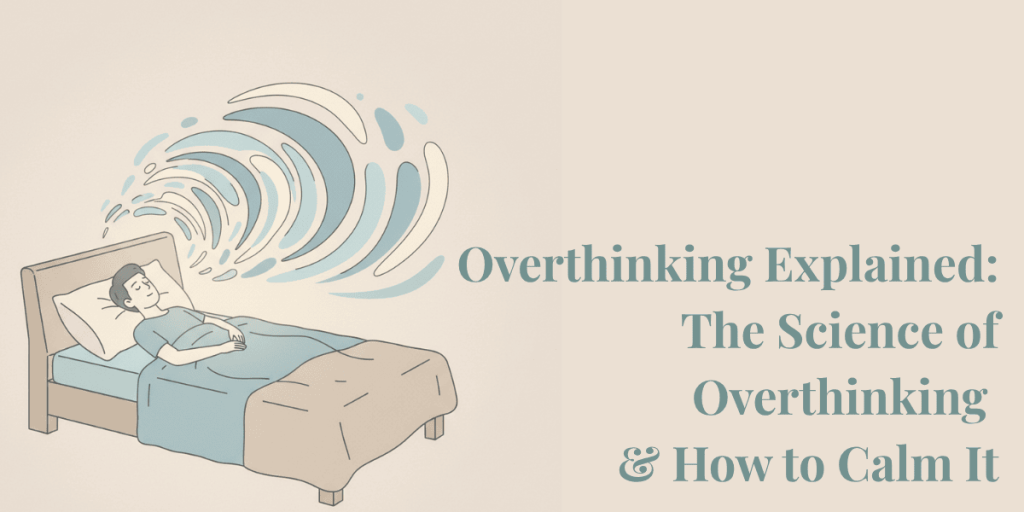
Overthinking Explained: The Science of Overthinking & How to Calm It
It is late at night. The room is quiet, the phone screen is finally dark, and yet your mind refuses to rest. Thoughts replay themselves like endless reruns. Conversations from the past, worries about tomorrow, and even unfinished to-do lists circle like restless birds. This is the world of overthinking, when the brain forgets how to pause.
Many people believe overthinking is simply a bad habit, but in truth, it is far more layered. It has roots in how the human brain is wired for survival. Understanding this makes it less of a personal flaw and more of a shared human experience. And when we understand it, we can learn how to invite calm into the noise.
The Science Behind a Restless Mind
The human brain is a prediction machine. It constantly scans for patterns, tries to fill gaps, and rehearses possible outcomes. This ability once kept our ancestors alive in dangerous environments. But in modern times, where most dangers are not tigers in the wild but emails, bills, and relationships, this survival system sometimes misfires.
Overthinking often happens when the brain gets stuck in a loop between memory and imagination. The past whispers “what if you had done it differently” and the future warns “what if things go wrong tomorrow.” The brain cannot tell the difference between real threats and imagined ones, so it keeps you alert even when you should be resting.
Signs of Overthinking You May Recognize
- Thoughts that circle the same topic without resolution
- Replaying past conversations or mistakes in detail
- Imagining every possible future scenario before making even simple choices
- Difficulty sleeping because your mind races
- Feeling mentally exhausted even after doing nothing physically
If you nodded to any of these, you are not alone. Millions silently live in the constant hum of mental noise.
The Emotional Cost of Never Switching Off
Overthinking is not only tiring, it steals presence. Conversations with loved ones get diluted because your mind is elsewhere. Rest feels impossible because silence only makes the thoughts louder. Even achievements lose their shine because instead of enjoying them, the brain asks what could have been done better.
And while overthinking does not show up on medical reports, its weight is deeply felt in the heart. The pressure builds invisibly, often mistaken as “just stress,” when in reality it is the exhaustion of a mind that never rests.
Why Talking Helps Calm the Mind
One of the simplest ways to stop thoughts from endlessly looping is to give them a place to land. Speaking thoughts aloud, without interruption, advice or judgment, changes their energy. Words that stay in the mind expand, but words that leave the lips start to shrink.
Unlike therapy, which focuses on solutions and diagnoses, pure listening spaces are about release. Imagine carrying a heavy backpack for hours. Putting it down, even for a while, changes everything. Talking works the same way. It does not erase the journey but makes it lighter to continue.
Small Everyday Shifts That Invite Calm
While overthinking may feel endless, small practices can help the brain rediscover stillness:
- Naming the thought
Instead of wrestling with the entire storm, focus on one thought and give it a name. For example: “This is my worry about tomorrow’s meeting.” Naming creates a distance that helps calm. - Voice journaling
Recording a voice note instead of writing. Speaking is often faster than writing and releases emotions more directly. - Creating safe pause moments
A cup of tea without a phone, a quiet walk, or simply five minutes of sitting without multitasking—tiny breaks help the brain slow its pace. - Choosing conversation over silence
Finding a trusted space to talk without fear of judgment allows thoughts to flow out instead of circling within.
The Hearmate Perspective
At Hearmate, we believe overthinking is not a weakness, it is a sign of an active, deeply feeling mind. Many people think they are “too much” because of their thoughts, but the truth is they are simply carrying more than they should alone.
When someone chooses to speak in a safe space, they are not seeking advice; they are seeking release. That release is powerful. It softens the edges of the racing mind, reminding it that silence and peace are possible.
A Gentle Reflection
If your brain rarely switches off, it does not mean you are broken. It means your mind has been doing its job, trying to protect you, predict for you, prepare you. But sometimes the protector needs to be protected.
Every thought you carry is proof that you care, about life, about people, about yourself. And caring deeply is never a flaw.
The next time the mind refuses to rest, remember this: you are not alone in the noise. Somewhere, others are also lying awake with their thoughts, waiting for calm. Sometimes, calm does not arrive as silence. Sometimes, it arrives as a voice, a conversation, a space where words can finally rest.
Conclusion
Overthinking is the echo of a mind that wants control in a world full of uncertainty. But the answer is not to fight it, nor to judge it. The answer is to gently release it—through pauses, through words, through listening spaces that remind us peace is possible.
When the brain never switches off, the heart can feel heavy. Yet with the right release, the heaviness can turn into lightness. And lightness is what allows us to truly live, not just think about living.
If your thoughts feel too heavy to carry alone
Hearmate offers a safe space to let them out. Not therapy. Not advice. Just listening, so your words can finally rest.
Book Your First Free Call